

by Kahla Verhoef
For years, aortic stenosis (AS) care has been largely reactive – patients are monitored until they become symptomatic or progress to “severe.”
That paradigm is changing, and the clinical evidence is no longer subtle.
With a growing number of device and drug trials focused on proactive intervention, hospitals are rethinking how they identify, monitor, and manage AS across the full disease continuum.
Discussions at ACC 2026 made one thing clear:
The future of aortic stenosis care requires proactive identification, longitudinal monitoring, and intentional pipeline management.
The Challenge: Scale, Complexity, and a Growing Treatment Gap
The numbers are significant – and growing. Despite 15 years of randomized trial evidence supporting TAVR across all surgical risk categories, only 61% of severe symptomatic AS patients are treated.ⁱ The gap widens as severity decreases: moderate-to-severe patients are evaluated 42% of the time and treated 25% of the time, despite evidence that their mortality risk is comparable to that of severe patients.ⁱⁱ These aren’t patients lost to the system. They’re known, documented – and still not receiving guideline-directed care in a clinical state where waiting bears an 11.6% six-month mortality risk.ⁱⁱⁱ

Perhaps even more striking, egnite Registry data shows that the average hospital has 4x more patients with untreated diagnosed moderate AS than untreated severe AS, and 68% of those patients already show major cardiovascular risk factors.ⁱᵛ Moderate patients are evaluated only 6% of the time.
At the same time, new upstream detection tools – such as ECG-AI – are identifying previously undiagnosed patients who now require echo, evaluation, and potential referral. This creates a dual challenge for health systems: close existing treatment gaps while preparing for a larger incoming pipeline.
CHALLENGE #1
Ensure severe AS patients are consistently identified and treated in a timely manner.
CHALLENGE #2
Build a durable pipeline of symptomatic moderate, symptomatic moderate-to-severe, and asymptomatic severe patients – including those newly identified upstream – to connect them with specialist teams before they become critical.
What Proactive Pipeline Management Looks Like in Practice
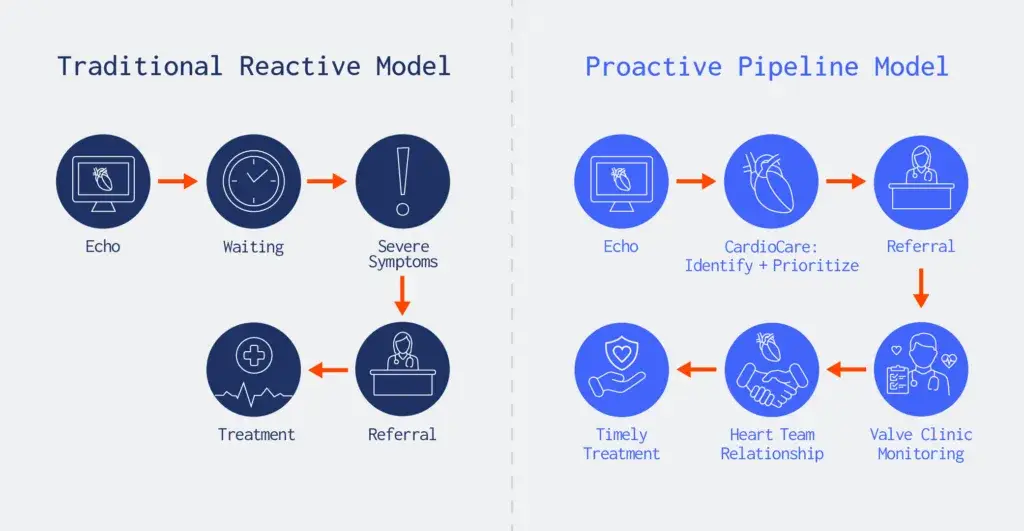
For severe symptomatic patients, the path is clear: identify, refer, treat. The harder question is what to do with moderate patients who show symptoms or signs of cardiac damage but don’t yet meet severity thresholds for intervention. Progressive programs are answering that question by bringing these patients into the valve clinic — not for the valve, but for the relationship. A symptomatic moderate AS patient who is already known to the heart team, with a baseline evaluation and monitoring cadence in place, is a patient who can be acted on quickly when the clinical picture changes. The alternative is a patient managed in general cardiology until they cross into severe, at which point the heart team meets them for the first time under urgent conditions.
Multiple ongoing randomized trials — including PROGRESS and EXPAND TAVR II — are testing whether earlier intervention in symptomatic moderate AS improves outcomes. If those results are positive, programs that have already built referral pathways and stratification workflows for this population will be positioned to act. Those that haven’t will be starting from zero.
Shifting referral patterns this way will put new pressure on valve clinic capacity and require programs to rethink scheduling, staffing, and stratification. But even for programs not yet ready to expand referral criteria, the foundational challenge remains: you cannot manage patients you cannot see. Most programs today lack a reliable, systematic way to know how many AS patients they have, where each one sits on the disease continuum, and whether the right next step has been taken — let alone be prepared when the evidence base expands to include the populations these trials are studying.
Why Proactive Intervention Is No Longer Optional
The RECOVERY trial (NEJM, March 2026) makes the case for early surgery with striking clarity.ᵛ In asymptomatic patients with very severe AS, early surgery reduced the combined endpoint of operative mortality or cardiovascular death from 24% to just 3% at 10 years. All-cause mortality was 15% vs. 32% in the watchful waiting arm. The EARLY TAVR trial (NEJM, January 2025) found that in asymptomatic severe AS patients, early TAVR reduced the composite of death, stroke, or unplanned cardiovascular hospitalization by half compared to watchful waiting (35.1% vs. 51.2%; HR 0.50).ᵛⁱ
Discussions at ACC 2026 reinforced what these numbers suggest: waiting for symptom onset often means the patient is already decompensating. AS progression is largely inevitable – 61% of patients with severe AS will receive an AVR within four years – and there is limited clinical benefit to delay.ᵛⁱⁱ Treatment thresholds continue to shift toward intervention at progressive stages of disease, with growing evidence supporting indication expansion and broader use of AVR across wider patient populations.
What remains underappreciated is what is lost during that delay. As patients wait, they continue to accumulate myocardial injury – LVH, fibrosis, atrial fibrillation, and pulmonary hypertension – that may ultimately limit outcomes even after successful AVR. The question is no longer whether to intervene, but when.
Why Patients Fall Through the Cracks
Today, many patients are missed not because of clinical uncertainty – but because of process. Aortic stenosis is documented inconsistently across echo reports, identification often depends on manual review or subjective interpretation, and referrals typically occur late, when disease is advanced and symptoms are obvious. An egnite analysis across 22 programs found that over 70% of unreferred severe symptomatic AS patients were under the care of non-heart team cardiologists – suggesting that the gap is less about clinical judgment and more about referral workflow.ᵛⁱⁱⁱ
In other words: clinical guidelines are moving toward proactive, system-level management. The tools and processes to execute that approach remain the gap.
The Role of Digital Tools
Managing AS at scale requires more than clinical expertise – it requires systematic visibility into care patterns. This is precisely the problem the CardioCare Platform was built to solve. The platform identifies AS patients directly from echo reports using proprietary NLP, based on how severity is described by the cardiologist, and enables heart teams to track patients longitudinally across the full disease continuum. It also flags echos that may warrant secondary review and identifies moderate AS patients whose progression patterns suggest higher risk. Because we know that surfacing a patient is not the same as treating one, CardioCare pairs its detection and tracking capabilities with dedicated clinical operations support.
The Bottom Line
Recent clinical trials, consensus statements, and real-world data all point the same way: AS care can no longer be organized around severity thresholds and symptom onset. Early identification reduces mortality. Progressive intervention changes outcomes. And the patients who fall through the cracks are not outliers – they represent a systemic gap that health systems now have the tools to close.
Success in AS programs will depend on more than procedural excellence. It will depend on the ability to systematically identify, track, and manage patients across the entire disease continuum.
AS care is no longer about reacting to severity. It’s about proactively managing progression – and access – at scale.