
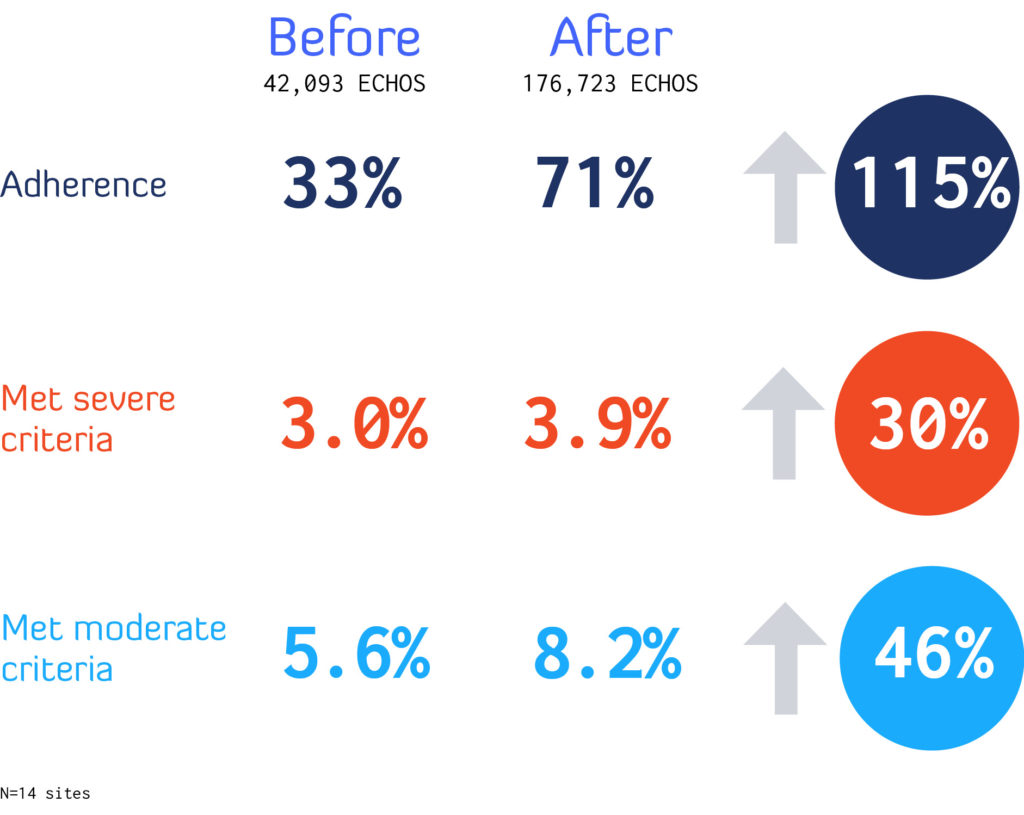

CASE STUDY: Standardizing the quality of care for structural heart programs

Standardizing the Quality of Care for Structural Heart Programs

Reducing variability in care

Patients with structural heart disease can take very different routes before reaching the heart team. It can be difficult to reduce variability in care across the hospital system for this large patient population. 

Improving quality across the care continuum

Related Articles

Press

egnite, Inc. Receives U.S. Patent for NLP-Based Algorithm That Classifies Mitral Regurgitation Mechanism from Echocardiographic Reports

egnite, Inc., a leading digital health company specializing in cardiovascular care, today announced the addition of two distinguished physicians, Vinod H. Thourani, MD and Nicholas Amoroso, MD to its Medical Advisory Board. Their wealth of expertise in cardiovascular care and dedication to innovation will significantly contribute to egnite’s mission to improve cardiovascular patient care nationwide.

Press

egnite Introduces Customer Access to Its National Cardiovascular Registry and Launches 2026 Call for Science Investigator-Initiated Study Program

egnite, Inc., a leading digital health company specializing in cardiovascular care, today announced the addition of two distinguished physicians, Vinod H. Thourani, MD and Nicholas Amoroso, MD to its Medical Advisory Board. Their wealth of expertise in cardiovascular care and dedication to innovation will significantly contribute to egnite’s mission to improve cardiovascular patient care nationwide.

egnite Research

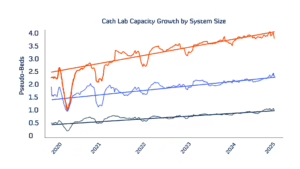
Cath Lab Capacity is Up—But Structural Heart Procedures Are Being Outpaced by Other Interventions

Heart failure with a preserved ejection fraction (HFpEF) accounts for more than half of all heart failure cases and carries significant morbidity and mortality risk, especially after hospitalization1. Historically, management of the disease is largely focused on comorbidity management and lifestyle modifications, given that available therapies had not demonstrated sufficient impact on hospitalization burden or mortality. In recent years, however, the treatment paradigm for HFpEF has shifted, with a growing emphasis on SGLT2 inhibitors (SGLT2i). Originally developed to lower blood glucose levels in diabetic patients, several clinical trials have firmly established that SGLT2i is also beneficial for patients living with HFpEF2.