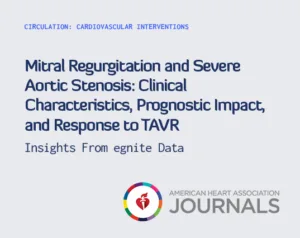

The egnite Registry contributed de-identified, longitudinal data, linking serial echocardiograms with clinical outcomes, to help answer what happens to patients after a successful mitral transcatheter edge-to-edge repair (M-TEER) procedure.
ALISO VIEJO, Calif. — October 13, 2026 — egnite, Inc., a cardiovascular intelligence company that helps clinicians identify and manage patients with untreated heart disease, today announced that Dr. John T. Saxon, Director of the Advanced Cardiac Valve Center at University of Virginia (UVA) Health, has been selected as the winner of its inaugural Call for Science grant program. His study, Long-Term Durability After Successful M-TEER: Insights from a Large, Real-World Imaging Database, will be presented as Featured Clinical Research at the Transcatheter Cardiovascular Therapeutics (TCT) 2026 conference in San Diego on October 31, 2026, at 11:15 a.m. PT.
The Call for Science is an investigator-initiated study (IIS) program that invited U.S.-based researchers to submit original study proposals using the egnite Registry, which includes de-identified data from approximately 14 million patients and 6 million echocardiograms. Selected research receives analytical support from egnite’s data science team.
Dr. Saxon’s study draws on approximately 6,000+ patients who underwent M-TEER. Of those, more than 2,000 had successful procedures and were followed for up to three years, with serial echocardiograms and clinical outcomes used to measure device durability and its effect on patients.
Contributing Evidence Where the Field Needs It Most
As M-TEER expands into lower-risk populations, durability has become increasingly important, yet long-term outcomes after an initially successful procedure remain poorly characterized. Answering the durability question requires linking how the device performs over time with what happens to the patient, and few data sources do both.
“Procedural registries, like the Transcatheter Valve Therapy (TVT) Registry, are excellent at defining short- and intermediate-term outcomes but lack longer-term data on recurrent mitral regurgitation (MR) and long-term treatment failure,” said Dr. Saxon. “Claims data from Medicare and Centers for Medicare & Medicaid Services (CMS) databases are excellent at defining long-term survival, but do not capture long-term device durability or, most importantly, the impact of device durability and treatment failure on survival. The egnite Registry is uniquely positioned to bridge that gap, with long-term data on both survival and device performance—via serial echocardiograms—that allows us to model the impact of MR recurrence on clinical outcomes.”
Dr. Saxon’s study shows what becomes possible when independent researchers can apply their own clinical questions to real-world data of this depth.
“When we launched our first Call for Science, our goal was to put the egnite Registry to work on the questions the field most needs answered,” said Michael Dobbles, Chief Data Officer at egnite. “Dr. Saxon’s study is a direct contribution to the patient outcomes and durability conversation happening across structural heart right now—that’s the kind of impact we hoped this grant program would have.”
About egnite’s Call for Science Initiative
The 2026 Call for Science Initiative is egnite’s first open call for research ideas through an Investigator-Initiated Study (IIS) grant. The initiative invited U.S.-based researchers to submit original study proposals, with the winning proposal receiving dedicated data science support and analysis using the egnite Registry.
About Dr. John T. Saxon
John T. Saxon, MD, is Director of the Advanced Cardiac Valve Center and Associate Professor of Medicine at UVA Health, where he specializes in transcatheter aortic, mitral, tricuspid, and pulmonary valve therapies. He has published extensively on structural heart interventions in journals including JACC: Cardiovascular Interventions and Catheterization and Cardiovascular Interventions, with a particular focus on long-term durability and outcomes following TAVR and mitral transcatheter edge-to-edge repair.
About egnite, Inc.
egnite, Inc. is a technology company advancing guideline-directed cardiovascular care and real-world evidence. egnite’s CardioCare® platform is deployed across 1,200 cardiovascular care facilities, including more than 80 heart surgery centers, that use the technology to identify and prioritize cardiovascular patients. CardioCare’s combination of practical AI, advanced clinical logic aligned to ACC/AHA guidelines, and workflow integration helps hospitals move more patients into evidence-based care pathways. The egnite Registry, built on de-identified EHR data from more than 14 million patients and 6 million echo reports, gives life sciences and research teams a longitudinal view of the patient journey. The company is headquartered in Aliso Viejo, California.
For more information, visit www.egnitehealth.com.
*The CardioCare platform is not intended for use in the diagnosis, cure, mitigation, treatment or prevention of cardiovascular diseases.
###
Media Contact
Jules Chong | jules.chong@egnitehealth.com